

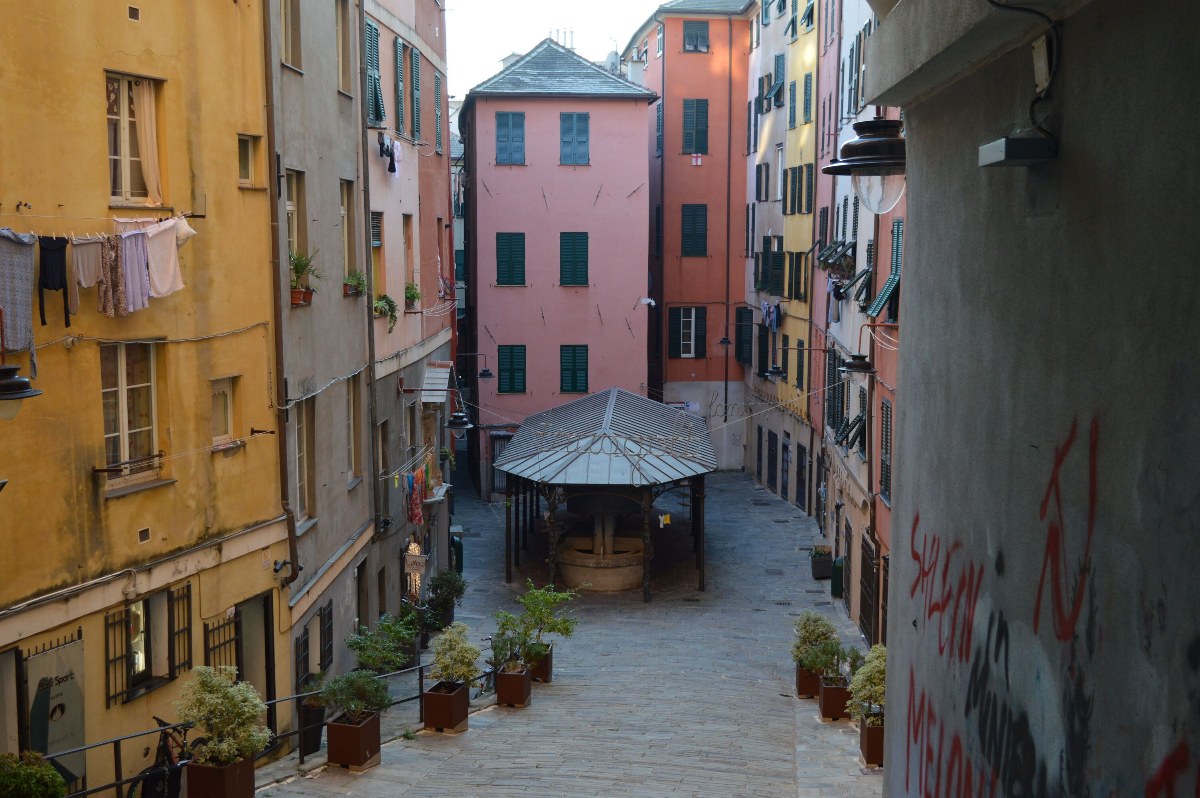
Genoa rarely makes a first-time Italy itinerary, and it should. Behind the port lies one of the largest medieval old towns in Europe, a dense maze of narrow alleys the Genoese call caruggi. It’s dark, tall and noisy, full of bakeries, tiny shops and palaces hidden behind plain doors, and it feels nothing like the polished postcard towns along the rest of the Ligurian coast.
Most trains from Milan, Turin and the French Riviera stop at Piazza Principe, on the western edge of the old town. If you arrive before you can check in, find bag storage in Genoa near the station and walk straight into the alleys. The caruggi are no place for a wheeled suitcase.
Table of Contents
How to explore the caruggi
The caruggi grew up in the Middle Ages, when Genoa was one of the richest maritime republics in the Mediterranean and space inside the walls was precious. Houses rose six or seven storeys high on either side of lanes sometimes barely wider than your outstretched arms, so the sunlight only reaches the bottom for a few minutes a day.
My advice is not to fight the maze. Pick a direction, wander, and use the sea as your compass: walking downhill almost always brings you out at the port. Some of the most atmospheric streets are Via del Campo, Via della Maddalena and Via San Luca, a long, busy shopping lane that runs parallel to the waterfront.
Look up as you walk. Many corners have small shrines to the Madonna set high on the walls, and the doorways of grand houses carry carved stone portals that hint at the wealth behind them. Some streets are lively until late, while a few of the quieter alleys near the port can feel a little rough after dark, so I’d stick to the busier lanes at night.
Via Garibaldi and the Palazzi dei Rolli
At the top of the old town, the alleys suddenly give way to Via Garibaldi, the old Strada Nuova. In the 16th century, Genoa’s richest families built their palaces along this one straight street, and the city kept an official list, the Rolli, of the grandest houses, which were obliged to host visiting royalty and dignitaries. In 2006 a group of these palaces became a UNESCO World Heritage Site.
Three of them now form the Musei di Strada Nuova, visited on a single ticket: Palazzo Rosso, Palazzo Bianco and Palazzo Doria-Tursi, which is also the city hall. Palazzo Bianco holds paintings by Caravaggio, Rubens and Van Dyck, and the courtyard of Doria-Tursi is free to walk into. Even if museums aren’t your thing, I’d step into a few of the open courtyards along the street to see the staircases and painted ceilings.
San Lorenzo and the old port
In the middle of the old town, the Cattedrale di San Lorenzo stands out with its black-and-white striped facade, Gothic portals and stone lions guarding the steps. Inside, look for the unexploded British naval shell that crashed through the roof in 1941 and is now displayed in the nave. The treasury museum holds the Sacro Catino, a green glass dish once believed to be the Holy Grail.
From the cathedral it’s a short walk down to the Porto Antico, the old harbour, redeveloped in the 1990s with a waterfront promenade. The Aquarium of Genoa is here, one of the largest in Europe, along with the Galata maritime museum. Even without going inside either, the walk along the water is a nice change from the dim alleys, with views of the Lanterna, the city’s 16th-century lighthouse.
Just behind the port, under the arcades of Via di Sottoripa, the old friggitorie have been frying fish for sailors since the 1800s. A paper cone of fried anchovies, squid and panissa, strips of chickpea polenta, is one of the cheapest and best lunches in town.
Focaccia, farinata and pesto
Genoa’s focaccia is thinner than most, with deep dimples that hold olive oil and coarse salt. Locals eat it in the morning, often dipped in a cappuccino, which sounds strange until you try it. I’d buy it early from a bakery in the old town while it’s still warm, because it’s never as good later in the day.
Farinata is the other essential, a thin, crisp pancake of chickpea flour, water and olive oil baked in a wide copper pan in a wood-fired oven. It’s traditionally served in sciamadde, old-fashioned shops with blazing ovens, and it’s best eaten hot with a grind of black pepper. Ask for a piece from the edge, where it’s crunchiest.
Then there’s pesto, which comes from here. In a proper Genoese trattoria it’s made with basil, pine nuts, Parmigiano, pecorino, garlic and olive oil, and served with trofie, short twisted pasta, or trenette, often with potatoes and green beans cooked in with the pasta. Real pesto is a deep, muted green, and it’s never heated.
Up to Castelletto for the view
To end the day, go up. From Piazza del Portello, just below Via Garibaldi, an Art Nouveau lift carries you up to the Spianata Castelletto, a terrace high above the old town. From the railing you look down over a jumble of slate roofs, church domes and bell towers, all the way to the port and the sea. Seeing the caruggi from above, you finally understand how tightly the city is packed together.
I’d go up in the late afternoon and stay for sunset, when the lights come on across the harbour. Afterwards, walk back down through the lanes for dinner. Once you know the caruggi a little, they feel less like a maze and more like the heart of the city.