

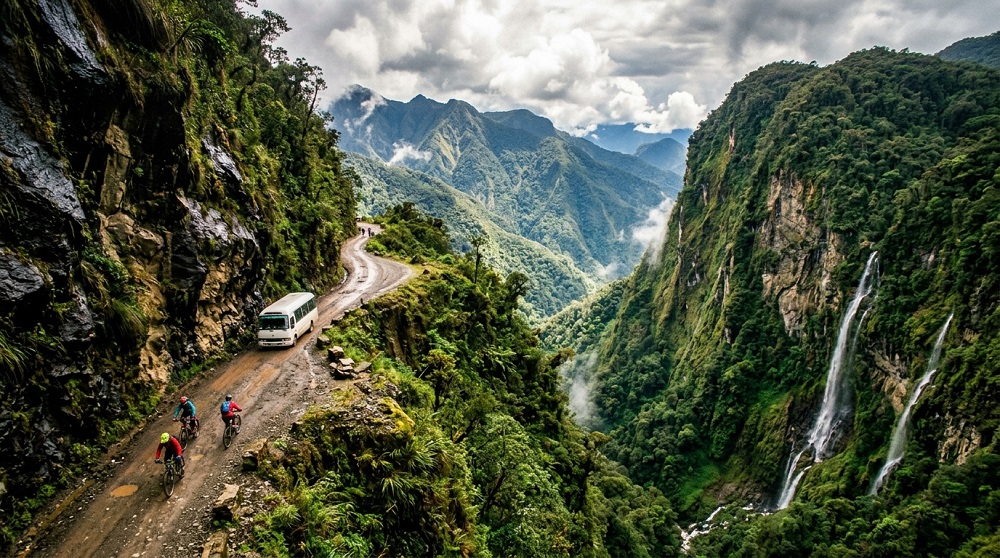
Bolivia is South America’s least-visited major destination and arguably its most dramatic — a country where the administrative capital sits at 3,600 metres and the Amazon basin starts a few hours’ drive downhill. It’s also the cheapest place on the continent to travel well. These ten stops cover the range.
Table of Contents
The Southwest: Salt and Lagoons
1. Salar de Uyuni
The world’s largest salt flat, roughly 4,000 square miles of blinding white hexagons. During the wet season a thin layer of water turns it into a mirror reflecting the sky; in the dry season you get the cracked geometric crust and cactus-covered Isla Incahuasi.
2. The Southwest Lagoons
Most Uyuni tours continue three days south through the Eduardo Avaroa reserve: Laguna Colorada stained red by algae and dotted with flamingos, the Sol de Mañana geyser field, and hot springs at over 4,000 metres.
The Altiplano
3. La Paz
A city poured into a canyon, with El Alto on the rim above. The Mi Teleférico cable car network doubles as public transport and the best city tour anywhere. Add the Witches’ Market, the Valle de la Luna rock formations, and cholita wrestling.
4. Lake Titicaca
The highest navigable lake in the world. Base in Copacabana, then take a boat to Isla del Sol, where Inca creation myth places the birth of the sun. No cars on the island — only footpaths between ruins.
5. Tiwanaku
A pre-Inca ceremonial complex near the lake, at its height around 1,000 years before the Incas arrived. The Gateway of the Sun and the sunken temple show masonry that still puzzles archaeologists.
Colonial Silver Cities
6. Potosí
Once among the richest cities on earth, funded by the silver of Cerro Rico at brutal human cost. Working mine tours are offered, though conditions are genuinely dangerous and many travellers find the ethics uncomfortable — the colonial mint museum is an alternative.
7. Sucre
Bolivia’s constitutional capital and its most attractive city: whitewashed colonial buildings, a mild climate, and Parque Cretácico, where thousands of dinosaur footprints stand on a near-vertical cliff face.
Canyons and Jungle
8. Torotoro National Park
Canyons, caves, and more dinosaur trackways, reached over a rough road from Cochabamba. Little visited and spectacular.
9. Samaipata
A relaxed valley town beside El Fuerte, a carved sandstone ceremonial site, with Amboró National Park’s cloud forest nearby.
10. Madidi National Park
One of the most biodiverse protected areas on earth, entered from Rurrenabaque. Community-run lodges offer jungle and pampas trips with excellent wildlife odds.
Planning Notes
Take Altitude Seriously
La Paz sits at around 3,600 metres and much of the southwest circuit runs higher. Ascend gradually where possible, rest on arrival, drink plenty of water, and skip alcohol for the first days. Persistent headache, breathlessness at rest, or confusion mean descending and seeking medical help.
When to Go
May to October is the dry season, with clear skies and passable roads. December to March brings the salt flat’s mirror effect but can flood access routes.
Cash and Connectivity
Bolivia runs on cash. ATMs are limited outside major cities and often out of service — carry bolivianos and some US dollars as backup.
Build in Slack
Road blockades and strikes are a normal part of Bolivian political life and can close highways with little notice. Never plan a tight connection to an international flight.
Two weeks covers the southwest, La Paz, and Sucre comfortably. Three lets you add the jungle.