

A festival changes what a place is willing to show you. Streets close, strangers become participants, and traditions that normally happen behind closed doors move outdoors. These ten are worth planning an entire trip around — grouped by the kind of experience they offer.
Table of Contents
Colour, Water, and Chaos
1. Holi, India
The spring festival of colours, celebrated across northern India in March. Powdered pigment fills the air, and social hierarchies loosen for a day. Mathura and Vrindavan hold the most traditional celebrations; Jaipur and Delhi are easier for first-timers.
2. Songkran, Thailand
Thai New Year, held from 13 to 15 April. What began as a gentle water-pouring blessing has become a nationwide water fight. Chiang Mai’s moat area is the epicentre. Protect your phone and expect to be soaked continuously.
3. La Tomatina, Spain
The last Wednesday of August in Buñol, near Valencia. Roughly 20,000 people throw more than a hundred tonnes of overripe tomatoes for one hour. Tickets are limited and must be bought in advance.
Parades and Processions
4. Rio Carnival, Brazil
The world’s largest carnival, held in the days before Lent. Samba schools compete in the Sambadrome with floats a year in the making, while free street blocos fill neighbourhoods across the city.
5. Gion Matsuri, Japan
Kyoto’s month-long July festival, running for over a thousand years. Enormous wooden floats are hauled through the streets on the seventeenth, built entirely without nails.
6. Inti Raymi, Peru
The Inca festival of the sun, re-enacted each 24 June at Sacsayhuamán above Cusco. Thousands of performers, ceremonial costume, and a Quechua-language script drawn from colonial accounts.
Fire and Light
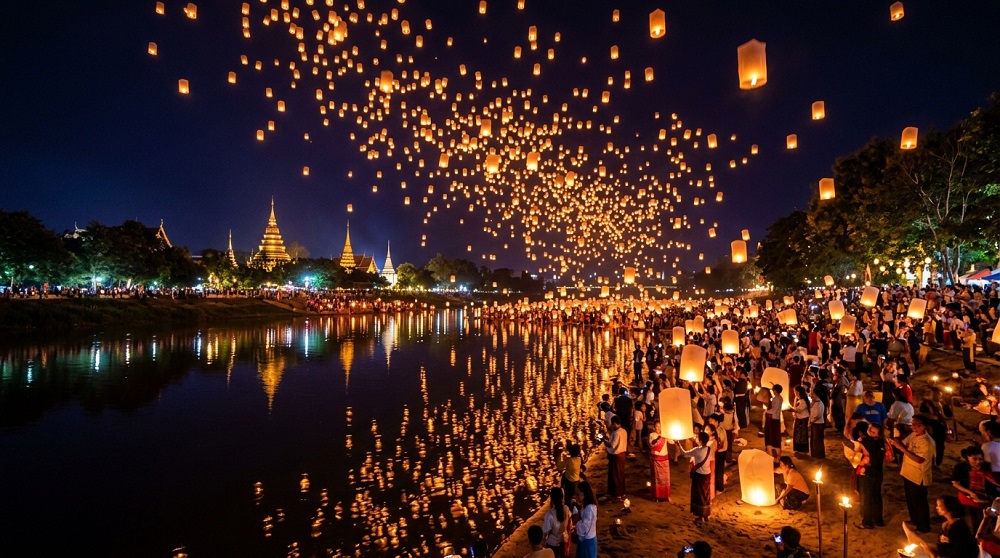
7. Yi Peng and Loy Krathong, Thailand
Held in November, when floating baskets go onto the rivers and paper lanterns rise into the sky. Note that mass lantern releases are now mostly restricted to ticketed events for aviation and environmental reasons.
8. Up Helly Aa, Scotland
Shetland’s midwinter fire festival, held in late January. Torch-bearing squads march through Lerwick before burning a replica Viking galley. Remote, cold, and completely unlike anything further south.
Remembrance and Feasting
9. Día de los Muertos, Mexico
From 31 October to 2 November, families build altars and hold graveside vigils for the dead. Oaxaca and Michoacán offer the most traditional observances. It’s a celebration, not a horror theme — approach it accordingly.
10. Oktoberfest, Germany
Munich’s sixteen-day beer festival, running from late September into early October. Six breweries, enormous tents, and full traditional dress. Table reservations open months ahead and are essential for evenings.
How to Plan Around a Festival
Check the Dates Every Year
Holi, Yi Peng, and Carnival all follow lunar or liturgical calendars, so the dates shift annually. Confirm before booking anything.
Book Far Ahead
Accommodation in Rio, Munich, and Cusco sells out six to twelve months in advance, and prices often triple during festival weeks.
Know What You’re Attending
Several of these are religious observances rather than parties. Ask before photographing people, dress appropriately at ceremonies, and follow the lead of locals around you.
Protect Your Valuables
Dense crowds attract pickpockets everywhere. Carry minimal cash, leave passports at your accommodation, and use a waterproof pouch at Songkran.
Arrive Early
The best festivals start before the headline event. Preparation days often show more of the culture than the main procession does.