

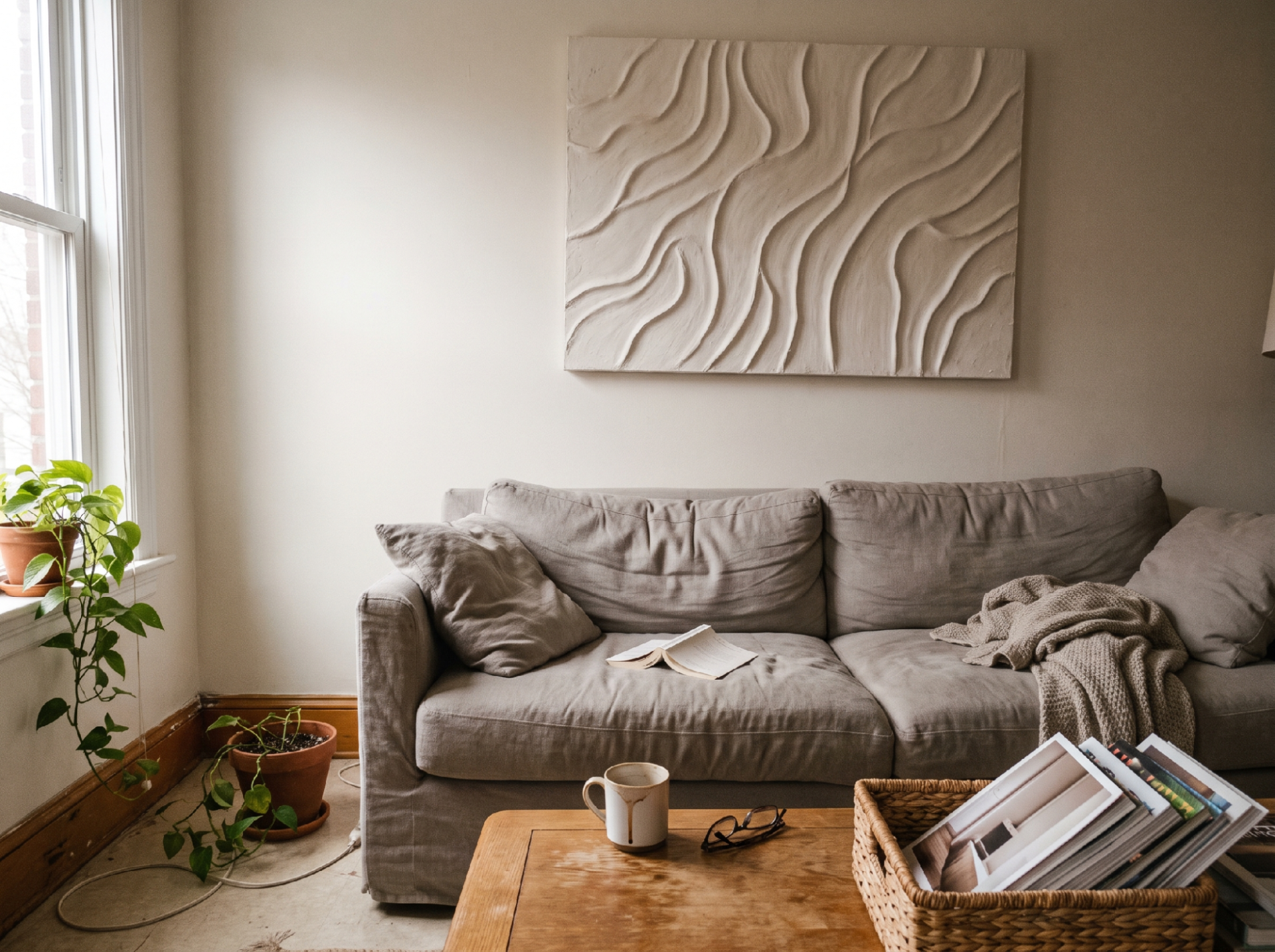
A living room built around texture, where wall art becomes part of the room’s architecture.
There’s a particular feeling you chase after a long trip: the moment you walk through your own front door and your shoulders finally drop. For that feeling to land, your home has to actually feel like somewhere, not a hotel room you happen to own. Flat, minimalist walls rarely pull that off.
That’s part of why 2026 is shaping up to be the year texture wins. Homeowners are trading flat prints and matte canvases for wall art you can practically feel from across the room, plaster ridges, raised layers, sculpted surfaces that catch the light differently depending on the hour. It’s a small change with a big effect: a home that greets you instead of just housing you.
Table of Contents
Why Texture Is Taking Over Flat Walls in 2026
Flat wall art had a long run. For most of the last two decades, minimalism meant clean lines, single-tone prints, and walls that stayed quiet so the furniture could do the talking. That’s changing, and it’s not just an aesthetic preference. Nearly 70% of homeowners now say texture is a primary factor when choosing wall art, and sales of textured décor, think plaster, resin, linen, and acrylic blends, have grown more than 40% year-on-year, according to Global Market Insights data cited by Acousart (2026). People aren’t just buying art anymore; they’re buying dimension.
Picture someone furnishing a living room after months of staring at rental-unit white walls on business trips. They want the room to feel lived-in the second they walk in, not staged. That’s usually where a single statement piece does the heaviest lifting, something like a large piece of three dimensional wall art hung above the sofa, where the raised layers throw real shadows instead of a printed illusion of them. One piece, placed well, can do more for a room’s warmth than an entire gallery wall of flat prints ever could.
The market backs this up at scale, too. The global wall art market is projected to hit roughly $70.94 billion in 2026 and climb toward $145.49 billion by 2034, a 9.39% compound annual growth rate, with wall art alone making up about 75% of the U.S. wall decor segment, according to Fortune Business Insights (2026). That’s not a niche trend. That’s a full-on move toward dimension over flatness.
The Wellness Case for Tactile Design
There’s more going on here than fashion. Wellness has stopped being a vague marketing word in interior design and started functioning as an actual performance metric. The American Society of Interior Designers’ 2026 Trends Outlook, sponsored by Sherwin-Williams, found that biophilic and sensory-driven design now top client priorities, not because it looks nice in a portfolio, but because clients are asking for it directly (ASID, 2026).
That tracks with what researchers have been documenting for a while. Tactile and olfactory interaction with natural, textured materials is linked to measurable drops in heart rate and cortisol response, according to research published via the National Institutes of Health (2026). In plain terms: touch and texture calm your nervous system down in ways a flat surface simply doesn’t.
For anyone who travels a lot, that matters more than the average homeowner might assume. A frequent traveler’s home has to do double duty, it’s a landing pad after red-eye flights, a place to decompress after a week of hotel rooms and airport food courts. A flat, sterile wall doesn’t help with that. A textured piece that catches morning light differently than it catches evening light gives your eyes, and apparently your nervous system, something to settle into.
The Data Behind the Trend
This isn’t a fringe design fad confined to a few showrooms. The global wall art market is projected to reach roughly $70.94 billion in 2026, climbing toward $145.49 billion by 2034 at a 9.39% compound annual growth rate, with wall art alone making up about 75% of the U.S. wall decor segment, according to Fortune Business Insights (2026). That kind of growth doesn’t happen because a handful of designers got bored of white walls. It happens because homeowners are actively asking for rooms that feel different to stand in, not just different to look at.
Bringing the Tactile Trend Home, Room by Room
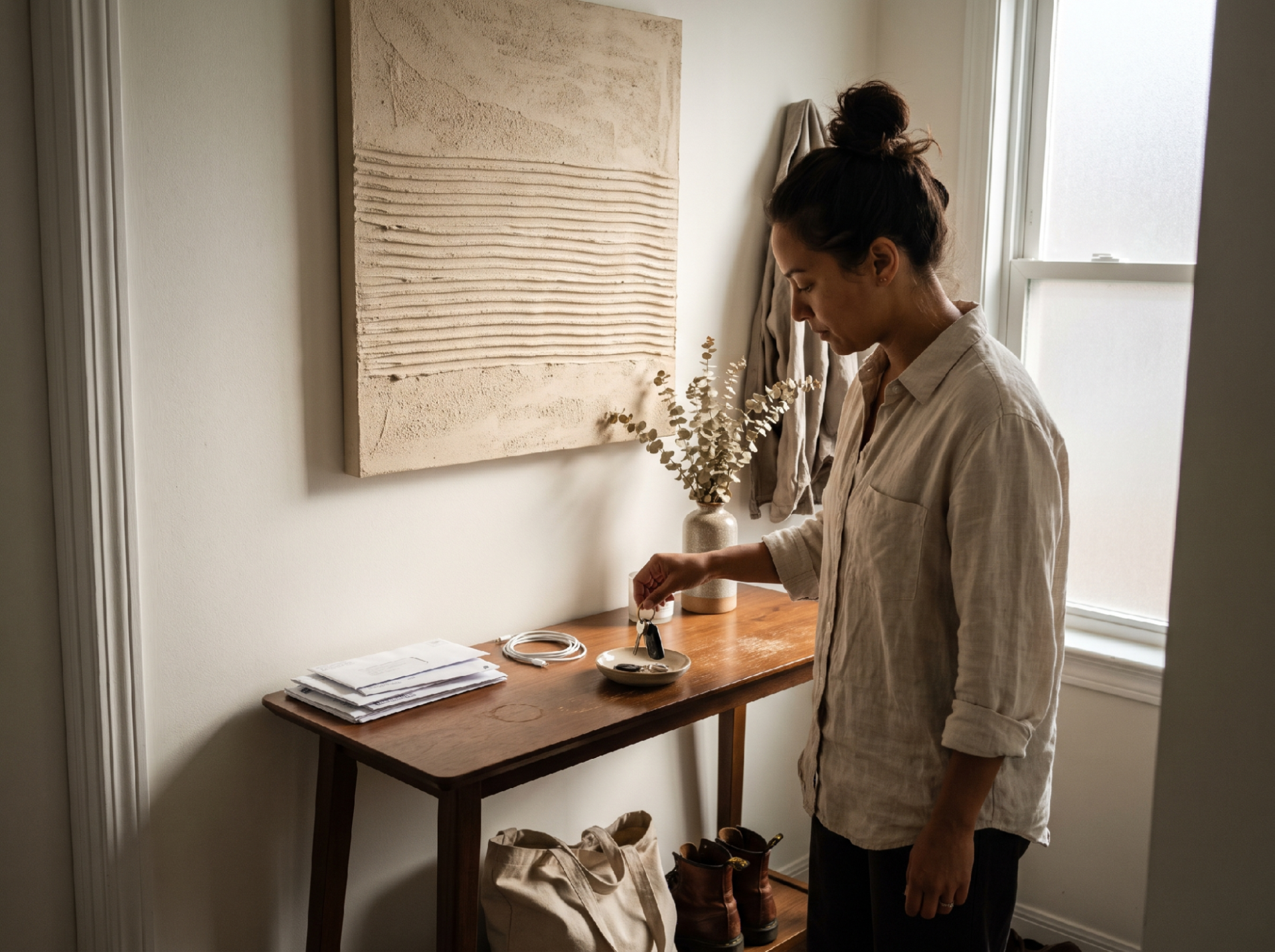
Even a single textured piece near an entryway can set a warm, grounded tone for the whole home.
You don’t need to redo every wall to get the benefit. A few room-by-room starting points:
- Entryway: A smaller textured piece above a console table sets the tone the moment you step inside, before you’ve even taken your shoes off. If the door itself is dated or drafty, even a thoughtfully chosen wall piece won’t fully land the effect, so a proper front door installation is sometimes the better starting point for an entryway refresh
- Living room: This is where a larger statement piece earns its keep, ideally above the main seating area, where shadow play changes throughout the day.
- Bedroom: Go subtler here. A single muted, textured panel above the headboard adds depth without competing with a room meant for rest.
If you’re already rethinking your layout after a long trip, this is a good moment to combine projects. A well-placed textured piece can visually anchor a room that doesn’t have much square footage to work with, which is exactly the kind of problem we dug into in our space-saving ideas for smaller rooms guide, pairing a tighter layout with a fresh wall feature tends to make the whole room feel more intentional rather than just tidier.
Styling Tips for a Sensory-Rich Space
Texture works best when it isn’t fighting for attention alone. Pair a dimensional wall piece with other natural materials nearby, wood shelving, woven baskets, ceramic vases, and the whole space starts to read as layered rather than assembled. It’s the difference between a room that looks decorated and one that looks collected over time. If you want to go further with natural layering, stone paneling is worth a look too. We walked through the details in our piece on layering natural materials like stone paneling, and it pairs surprisingly well with plaster-textured art in the same room.
Shopping habits have moved toward this look as well. Online channels now account for 58% of wall art purchases, compared to 34% through retail and just 5% through galleries, and gallery-wall configurations such as diptychs, triptychs, and sets of three remain the most consistently searched format, according to market data compiled by Rossetti Art (2026). People aren’t waiting for a gallery visit to find the right piece; they’re scrolling for it between flights.
One honest caveat: texture isn’t the right call for every wall. A busy, high-traffic hallway can get visually noisy fast if you layer too many dimensional pieces close together. Pick one or two focal walls and let the rest of the room stay calmer around them.
The Home You Actually Want to Come Back To
None of this is really about wall art trends for their own sake. It’s about what a home is supposed to do for you, especially if you spend a good chunk of the year somewhere else. Flat walls don’t ask anything of you and they don’t give much back either. Texture does both: it catches your attention when you walk in, and it settles you down once you’re there.
You don’t need to renovate anything to feel this. One well-placed dimensional piece, a little natural material layered around it, and a home stops being a place you simply return to. It starts feeling like the place you were trying to get back to the whole time.
1 thought on “The Tactile Home: Why 2026’s Biggest Interior Design Trend Is All About Texture”
Comments are closed.