

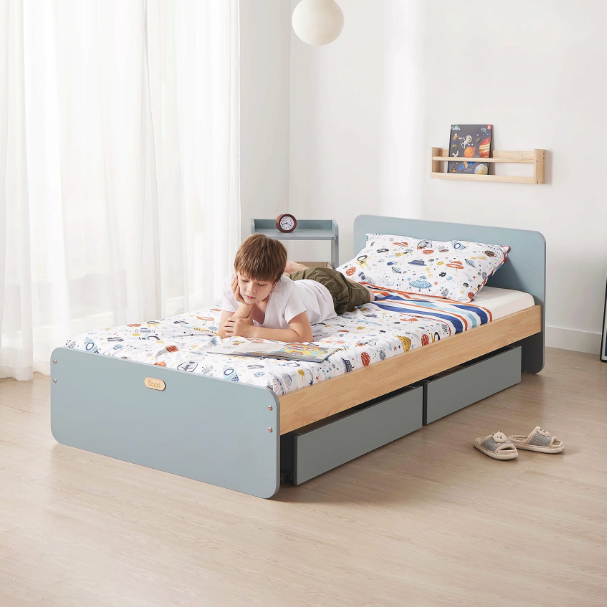
September in Australia marks the return to school after the winter break, and for many Australian families it also marks the moment when the children's bedroom — where homework happens, sleep recharges, and study habits form — gets its most honest annual assessment. A kids bed is the structural anchor of this bedroom, and the choice of configuration — standard single, king single, storage bed, or loft — determines how well the room serves both the sleep and study demands of the Australian school year. This September, with back-to-school bedroom refresh searches peaking across Australia, this guide connects the kids bed decision to the academic and developmental needs of the Australian school-age child.
Table of Contents
How the Kids Bed Configuration Affects Study Performance
Does the type of kids bed affect how well an Australian child studies?
The kids bed configuration does not directly affect cognitive performance, but it significantly affects the functional organisation of the Australian child's bedroom — which in turn affects study habit consistency. A loft bed or mid-sleeper that elevates the sleeping surface creates a dedicated study zone beneath the raised platform, physically and psychologically separating the study space from the sleep space in a way that a ground-level bed with a desk elsewhere in the same room cannot achieve. Australian educational research on home learning environments consistently identifies the dedicated, bounded study space as one of the most reliable predictors of consistent homework completion across the primary and secondary school years.
Kids Bed Size and the Australian School Year
What kids bed size serves Australian primary school children best across the school year?
The Australian standard single at 92 x 188 cm serves most primary school children from the cot transition through to approximately age 10 to 12, providing the sleep surface appropriate for the 9 to 11 hours of developmental sleep that Australian primary school children require for the cognitive consolidation, memory formation, and physical development that the school year demands. For Australian children in Year 5 and above who are approaching the physical limits of the standard single, the king single at 107 x 203 cm provides the size upgrade that supports the better sleep quality associated with adequate sleep surface dimensions — a connection that Australian sleep researchers have identified as meaningful for school-age academic performance.
The September Bedroom Refresh: What Australian Families Are Prioritising
|
Bedroom Refresh Priority |
Percentage of Australian Families (Sept 2025 Search Data) |
Primary Driver |
Kids Bed Implication |
|
Adding or upgrading study desk |
Most searched |
Back-to-school study demands |
Loft or mid-sleeper creates integrated desk zone |
|
Upgrading from single to king single |
Second most searched |
Child outgrowing current bed size |
King single purchase or upgrade timing assessment |
|
Adding under-bed storage |
Third most searched |
Bedroom organisation for school year |
Storage bed purchase or rolling bins under existing bed |
|
Full bedroom furniture refresh |
Fourth most searched |
End-of-primary or start-of-secondary transition |
Complete kids bed and furniture system reassessment |
|
Cot to first kids bed transition |
Fifth most searched |
New sibling arriving in spring |
First kids bed selection and nursery reconfiguration |
Choosing a Kids Bed for the Study-Heavy Secondary School Years
What kids bed configuration best serves Australian secondary school students?
Australian secondary school students face study demands that differ significantly from primary school years: longer homework sessions, multiple concurrent subjects, digital study tools requiring charging and cable management, and the study timetable pressure of senior years from Year 10 onward. The kids bed configuration that best serves this study-intensive stage is a king single at 107 x 203 cm on a standard height frame with adequate floor clearance for a quality study desk and chair positioned at the optimal location in the Australian student's bedroom — typically facing the wall, perpendicular to the window, with the window providing side natural light rather than direct glare on a laptop screen.
Spring Sleep and Australian School Performance
Why does spring sleep quality matter for Australian school performance?
The Australian spring coincides with the final school term of the year — Term 3 ends in late September in most Australian states, and Term 4 runs from October through December — making September the start of the most academically demanding period of the Australian school year for primary and secondary students, with year-end assessments, exams, and final projects concentrated in the October-to-December window. The quality of the Australian child's sleep during this period directly affects the cognitive performance that determines school outcomes. A kids bed that is too small for the child's current body dimensions produces measurably poorer sleep quality through increased night-time movement and waking, making the size assessment as relevant to school performance as any study furniture decision.
The Australian Kids Bed Investment Calculation
How should Australian families calculate the real cost of a kids bed investment?
The real cost of an Australian kids bed is the purchase price divided by the years of service at the appropriate size for the specific child — not the upfront price alone. A quality solid timber Australian single kids bed at AUD 600 that serves from age three to twelve provides nine years of service at AUD 67 per year. A budget alternative at AUD 200 that requires replacement at age six due to structural degradation provides three years of service at AUD 67 per year — identical annual cost for significantly lower quality and sleep safety across those three years. The quality investment calculus consistently favours solid timber construction over budget alternatives when the full service period is included in the cost calculation.
Frequently Asked Questions
Is September a good time to buy a kids bed in Australia?
September is the start of the back-to-school season in Australia, which coincides with peak children's bedroom furniture search and purchase activity. Quality specialist Australian children's furniture retailers typically carry their full range during this period, making it a practical purchasing window. The peak demand period also means Australian families who want specific configurations — particularly loft beds and storage beds — should order early in September rather than waiting until Term 4 begins, as lead times for quality Australian children's furniture can extend to four to six weeks during peak periods.
At what age should an Australian child have a dedicated study space in their bedroom?
Australian children benefit from a dedicated study surface in their bedroom from Year 1 at approximately age five to six, when regular school reading and homework begins. A small desk at the correct height for the specific child's body dimensions provides the physical study environment that supports consistent homework completion across the primary school years. For Australian children in smaller bedrooms, a loft or mid-sleeper kids bed with an integrated desk beneath the elevated platform provides both the sleep surface and the study zone within the same floor footprint.
How does the Australian school term structure affect kids bed purchasing timing?
Most Australian families make bedroom furniture changes between school terms rather than during them, making the September inter-term period and the December-January summer break the two peak purchase windows for Australian kids beds. The September window is particularly common for families whose child is starting a new school year stage — primary to secondary, or a new primary year level — that creates new bedroom and study space requirements.
Can a quality Australian kids bed improve sleep duration in school-age children?
A correctly sized Australian kids bed on a quality medium-firm mattress does not directly increase sleep duration, but it reduces the sleep fragmentation associated with inadequate sleep surface dimensions. An Australian primary school child whose body width approaches the 92 cm standard single mattress edge during sleep will experience more night-time movement and micro-waking than the same child on a king single with adequate turning space — a difference that can translate to meaningfully better sleep quality across the school year for children who are active sleepers.
Final Thoughts
The back-to-school bedroom refresh of September 2025 gives Australian families the practical moment to align the kids bed configuration with the sleep and study demands of the Australian school year ahead. Australian families comparing current kids bed configurations can browse boori.com.au/collections/kids-bed