

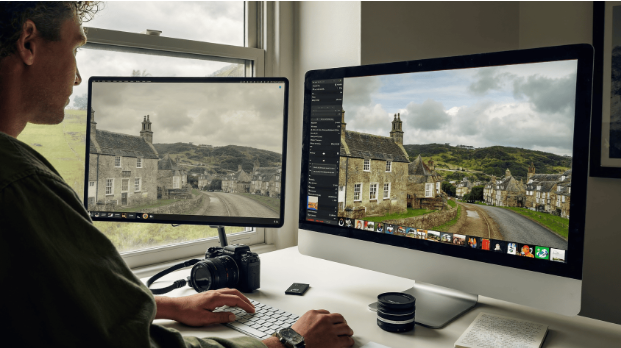
You walk two hours to a viewpoint in the Yorkshire Dales and the sky is a sheet of white. Not raining, not clear, just the particular grey that sits over Britain for most of the year. The valley below looks enormous and the photograph you take of it looks like nothing at all.
That gap between standing somewhere and photographing it is wider here than almost anywhere, and it is not your camera. Flat overcast light removes the one thing a landscape photograph depends on, which is the shadow that tells you a hill is a hill.
Most people respond by taking the photo anyway, feeling vaguely disappointed, and never looking at it again.
Some of those photographs are considerably more recoverable than they appear. Nano Banana, Google’s image model family, can handle a good portion of the restoration work, while Higgsfield offers additional creative options for refining images. However, there is one correction that crosses a line you should not cross.
Table of Contents
Why does grey light ruin a landscape photograph?
Because it removes modelling, which is what makes a three-dimensional place look three-dimensional in a flat image.
Direct light creates shadows. Shadows tell the eye which surfaces face toward the light and which face away, and from that the brain reconstructs the shape of the land. Remove them and a valley becomes a flat green area with some texture in it.
It also removes separation. On a sunny day a near hill is brighter than a far one and the distance reads clearly. Under cloud everything sits at roughly the same brightness and the depth collapses.
And the sky is the specific problem:
- Overcast sky is considerably brighter than the ground beneath it
- Expose for the land and the sky blows out to pure white
- Expose for the sky and the land goes muddy
- Either way a large part of your frame is doing nothing
That white rectangle at the top of the frame is what makes most British landscape photographs look amateurish, and it is not a skill issue.
What actually works in flat light?
Quite a lot, once you stop trying to photograph the thing that needs sunshine.
Overcast light is soft and even, which is excellent for several subjects and terrible for one. The one it is terrible for is the big view.
What it genuinely suits:
- Woodland, where direct sun creates impossible contrast and cloud makes everything readable
- Waterfalls and streams, where soft light plus a slower shutter is the classic combination
- Stone and architecture, where even light shows texture without harsh shadow
- Detail and close subjects, where you are not relying on distance at all
- Villages and streets, where the colour comes from the buildings rather than the light
So the practical response to grey weather is not to photograph the valley badly. It is to walk down into the woods.
How should you compose when the sky is useless?
By leaving it out, mostly.
This sounds obvious and almost nobody does it. The instinct is to include sky because landscape photographs have sky in them, and the result is a third of the frame given to a blank area.
A few things that work:
- Crop the sky to a sliver or remove it entirely, which immediately makes the photograph about the land
- Find a frame, meaning a tree, an arch, a gate, anything that gives the eye an edge
- Shoot downhill rather than across, since looking down removes the horizon
- Use water, which picks up whatever light exists and gives you a bright element that is not white sky
- Get closer, which is the oldest advice in photography and still the best
A photograph of a drystone wall running into mist is a better photograph than a wide view with a white sky, and it is more honest about what the day was actually like.
Does rain help or hurt?
Helps, more often than people expect, which is the opposite of what everybody assumes.
Wet surfaces saturate. Stone goes darker and richer, leaves deepen, moss becomes vivid, and a wet path reflects light along its length. A village street photographed in drizzle has considerably more colour in it than the same street dry under cloud.
Mist is better still. It separates near from far, which is the exact problem flat light creates, and it does the job cloud cannot.
A few practical notes:
- Shoot just after rain stops, when everything is wet and the light frequently improves
- Carry a cloth, because a drop on the lens ruins every frame and you will not notice until later
- Protect the camera but keep shooting, since the best conditions are usually uncomfortable
- Look for reflections in puddles, wet pavement and standing water
The days people stay in are frequently the days worth going out.
What can Nano Banana recover?
The contrast and the colour, which is most of what grey light took.
- Nano Banana contrast recovery, which puts back the separation between near and far that flat light is removed. This is the single biggest improvement available.
- Nano Banana colour correction, because overcast light is noticeably blue and British landscape photographs frequently come out cold in a way they did not look at the time.
- Nano Banana shadow and highlight balance, where there is usually far more detail in a flat file than the screen is showing.
- Nano Banana sky recovery, where the sky is bright but not fully blown, which brings back whatever texture the cloud actually had.
- Nano Banana consistency across a set, so photographs from a four-day trip in changing weather sit together rather than looking like four different trips.
Higgsfield runs Nano Banana in the browser as part of an AI creative suite, which matters if you are working through a trip’s photographs on a laptop in a holiday cottage rather than at home.
Most people are surprised by how much a Nano Banana pass finds in a flat file. The information is usually there and the screen is just not showing it.
What should never be changed?
The sky, when it was not there. And the place, ever.
Nano Banana sky replacement is the specific temptation in British landscape photography because the weather is the problem and the fix is one click away. It is also the most common dishonesty in travel photography and the easiest to spot.
Why it matters:
- The light will not match. A blue sky implies directional sunlight, and a landscape lit by flat cloud underneath it reads as wrong even to people who cannot say why.
- Somebody is planning a trip from your photograph. They arrive expecting what you showed them.
- It misrepresents the place. Northern England is not Tuscany and pretending otherwise helps nobody.
Beyond skies, the same rule applies to everything else:
- Never remove a building, a pylon, a road or a fence because it spoils the view
- Never alter the landscape itself
- Never change the season or conditions you were there in
- Never add weather, light or atmosphere that was not present
Lifting the shadows in Nano Banana is correcting a photograph. Adding a sunset is making one up.
Does any of this apply to phone photos?
Almost entirely, and most people reading this are shooting on a phone.
Phones handle flat light reasonably well because their processing is built to produce something usable from difficult conditions. What they do badly is the specific British problem of a bright white sky above a dark landscape, where the automatic exposure splits the difference and satisfies nobody.
A few things that help before you edit anything:
- Tap to expose on the land, not the middle of the frame, and let the sky go
- Turn off the automatic enhancement if your phone has an obvious one, since it tends to overcook flat scenes
- Shoot in the highest quality setting available, because there is more to recover from
- Take several, as the processing varies between shots more than people realise
Phone files are more processed than camera files, which means slightly less headroom when you come to correct them. A Nano Banana pass still recovers a useful amount, particularly in contrast.
The other advantage is that you have it with you, which is the whole reason most British landscape photographs get taken in bad weather in the first place. Nobody carries a camera up a hill in the rain. Everybody has a phone in their pocket.
Where is grey light actually an advantage?
Northern England specifically, which is worth saying because the weather there is relentless and the photography can still be excellent.
Mist on the moors, wet stone in the Dales villages, soft light through woodland, dark water in the Lakes. Those are not consolation prizes for a cloudy day. They are the thing people travel there for.
If you are planning a trip around that sort of landscape, the guide to hidden gems in Northern England covers locations that reward exactly these conditions rather than needing a clear day to work.
Scotland and Wales behave similarly. So does the Peak District, where the grit of the landscape suits flat light better than sunshine does.
The south is different. Coastal Dorset, the Sussex downs and the chalk cliffs genuinely do want sun, and a grey day there is harder to work with.
How do you handle a whole trip of bad weather?
By editing as a set rather than rescuing individual frames.
A week in Britain usually produces a mix. One decent morning, three flat days, some rain, and a sunset that lasted four minutes. Treating each photograph separately produces an inconsistent gallery.
A reasonable approach:
- Sort by day first, since light within a day is usually similar
- Correct one frame properly in Nano Banana from each day and apply that treatment to the rest
- Accept that some days were grey and let those photographs be grey, slightly lifted
- Do not push the flat days toward the sunny ones, which produces an obviously processed look
- Pick fewer, because twelve good photographs beat sixty mediocre ones
The set should look like a week in Britain. That is what it was, and a gallery that admits it is more interesting than one pretending otherwise.
What would one trip’s photos take?
An evening, realistically.
- Go through everything before opening Higgsfield and pull the ones worth working on, which is fewer than you think
- Group them by day and by conditions
- Correct one frame from each group until the contrast and colour look like what you remember
- Apply that across the group in Nano Banana
- Check the Higgsfield output on a phone, since that is where most people will see them
- Keep the originals separately from Higgsfield, untouched
Then look at the whole Higgsfield set together before publishing anything. Individually they might all be fine and collectively they can still be a mess.
Conclusion
The reason British landscapes are hard to photograph is not skill and not equipment. It is that the light is flat most of the year, and flat light removes the shadow a landscape photograph needs.
Nano Banana puts back a surprising amount of the contrast and colour that got lost, and Higgsfield runs it in a browser, which is all you need on a wet afternoon indoors.
What it will not do is give you a sky you did not have. The day was grey, the stone was wet, and that is genuinely what people go there for.