

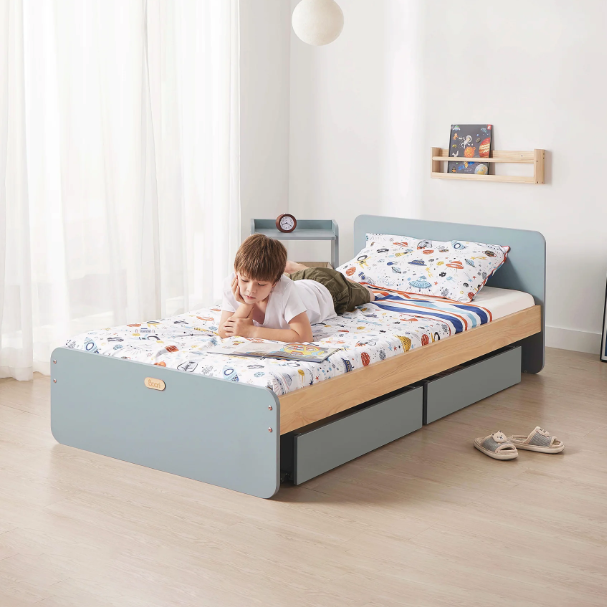
September's return to school is the moment when British families look at their children's bedrooms with fresh eyes — and often find that the sleep and study setup that limped through the summer is genuinely inadequate for the focused academic demands of the school year ahead. A kids bed sits at the centre of this assessment: its configuration determines how much floor space remains for a study desk, how well the child sleeps on the correctly sized surface, and whether the bedroom as a whole can serve both the sleep and study demands of the British primary or secondary school year. This September, this guide connects the kids bed decision to the academic and developmental context of the British school year in a way that the standard product specification never does.
Table of Contents
The British School Year and the Sleep Requirement
How much sleep do British school-age children need across the school year?
British primary school children require 9 to 11 hours of sleep per night across the school year for the memory consolidation, cognitive processing, and physical development that the school day demands. British secondary school students require 8 to 10 hours. These figures are consistent across NHS and British sleep research guidance and remain the most reliable targets for British school-age sleep regardless of the specific year group. A kids bed that is too small for the British child's current body dimensions — producing the sleep fragmentation associated with inadequate turning space — directly affects the quality of sleep that these targets intend to deliver, making the size assessment a genuine academic performance consideration in addition to a comfort consideration.
The September Bedroom Refresh: What British Families Are Prioritising
What kids bed and bedroom changes are British families most commonly making in September 2025?
British AI search and retail data from September 2025 shows five dominant back-to-school bedroom refresh priorities. The most searched is adding or upgrading a study desk — reflecting the homework and study space demand that accelerates from Year 5 onward in the British education system. The second is upgrading from a standard single to a small double or European single bed for older British children. The third is adding under-bed storage to serve the increased volume of school materials the returning British child brings into their bedroom. The fourth is a full bedroom furniture refresh at the start of secondary school. The fifth is the first post-cot kids bed for British toddlers transitioning before their school-age sibling returns in September. Each reflects a different stage of the British child development arc.
|
British School Transition |
Age |
Sleep Need |
Study Demand |
Best Kids Bed Config |
Key September Action |
|
Reception / Year 1 entry |
4-6 years |
10-11 hours |
Minimal: reading practice |
Standard UK single (90x190cm) |
First dedicated bed; reading corner adjacent |
|
Year 3-4 mid-primary |
7-9 years |
9-11 hours |
20-30 min homework |
Standard single or storage bed |
Add desk if not present; assess storage |
|
Year 5-6 upper primary |
9-11 years |
9-11 hours |
30-45 min homework |
Single or small double if room allows |
Study space priority; desk upgrade |
|
Year 7-9 early secondary |
11-14 years |
8-10 hours |
1-2 hours homework |
Small double or single with quality desk |
Full bedroom study zone assessment |
|
Year 10-12 senior secondary |
14-18 years |
8-9 hours |
2-4 hours study daily |
Small double; maximum study space |
Study infrastructure priority over bed upgrade |
The Small Double: Britain's 2025 Kids Bed Upgrade Trend
Why are British families increasingly choosing small double beds for older children in 2025?
The small double at 120 x 190 cm has emerged as the dominant British kids bed upgrade choice for children aged 12 and above in 2025, overtaking the European single at 90 x 200 cm as the preferred size step for British upper primary and secondary school children. The small double's 30 cm width advantage over the European single provides the sleeping surface that better accommodates the active sleep of British adolescents and the weekend morning reading, phone use, and sibling or parent company that older British children's beds must serve beyond the overnight sleep function alone. The small double also serves as the first genuinely adult-sized bed that the British child will not outgrow through to adulthood, eliminating the further size change that the European single still requires for some British teenagers.
Bed Configuration and British Bedroom Study Space
How does the kids bed configuration affect the study space available in a British child's bedroom?
The kids bed configuration determines the remaining floor space available for the study desk that British school-age children need from approximately Year 1 onward. In a typical British semi-detached or terraced house children's bedroom of 9 to 11 square metres, a standard single bed and a desk together consume approximately 3.3 to 4 square metres of floor space — leaving 5 to 7 square metres for a wardrobe, clothing storage, and circulation. A loft or mid-sleeper kids bed that integrates the desk into the under-bed zone provides both sleep and study within the same 1.7 square metre floor footprint, recovering 1.5 to 2 square metres for the wardrobe, circulation, and personal space that British children's bedrooms must also serve across the school year.
The Quality Investment: British Kids Beds for the Full School Journey
How should British families calculate the real value of a quality kids bed investment?
A quality solid timber British kids bed at £500 to £700 serving from age five through age sixteen provides eleven years of daily use at £45 to £65 per year — less than the cost of one quality British school textbook per year of service. A budget alternative at £150 to £200 that requires structural replacement at age nine due to joint degradation costs £150 to £200 plus a replacement of £200 to £300 — a total of £350 to £500 for a significantly lower quality sleep environment across the early years when quality matters most. For British families who frame the kids bed as a one-time eleven-year investment rather than a series of age-stage replacements, the quality solid timber bed almost always represents better financial value alongside the sleep quality, safety margin, and Consumer Rights Act protection that come with quality UK children's furniture.
Frequently Asked Questions
Is September a good time to upgrade a British child's kids bed?
September is one of the two peak British kids bed purchase periods — alongside January — driven by the back-to-school bedroom refresh motivation and the post-summer assessment of whether the child's current bedroom setup serves the school year ahead. Quality UK specialist children's furniture brands carry their full range during this period, but popular configurations such as loft beds and storage beds in solid timber may have four to six week lead times during the September peak. British families who want a specific configuration should order early in September rather than waiting until October when the school year's study demands are already being felt.
What kids bed size suits most British primary school children?
The standard UK single at 90 x 190 cm suits most British primary school children from the cot transition at approximately age two to three through to approximately age 10 to 12, when body height and width approach the standard single's practical limits for active British sleepers. For British children in the upper height percentile for their age who are already approaching 150 cm in height at age nine to ten, the European single at 90 x 200 cm or the small double at 120 x 190 cm provides a more appropriate size for the secondary school years without a further upgrade.
Do British kids beds need to comply with a specific safety standard?
Standard single and small double British kids bed frames are covered by UK Consumer Law requiring satisfactory quality and structural safety. For bunk beds and loft configurations with an elevated sleeping platform specifically, British Standard BS EN 747 applies, governing guard rail heights, maximum mattress depth on the top berth, and ladder safety specifications. Confirm BS EN 747 compliance from the UK retailer for any elevated sleeping configuration for British children.
How do British parents balance kids bed quality with bedroom renovation budget?
The most financially sound British bedroom renovation prioritises the kids bed as the highest-quality piece within the total budget, and addresses desk, storage, and decorative elements with more budget-conscious selections. The kids bed's 10 to 11 year service period means quality investment is most efficiently directed there; a desk at £120 that serves adequately for five years and is then replaced is a more appropriate budget approach than a £500 desk alongside a £150 bed that requires replacement in four years. Prioritise quality where service length justifies it; accept adequate for items with shorter service relevance.
Final Thoughts
The September back-to-school bedroom refresh is the most practically motivated kids bed assessment moment in the British calendar — when the sleep and study demands of the year ahead are most clearly visible and the investment in the right configuration is most directly valuable. British families can browse current kids bed options for the British school year at boori.co.uk/collections/kids-beds