

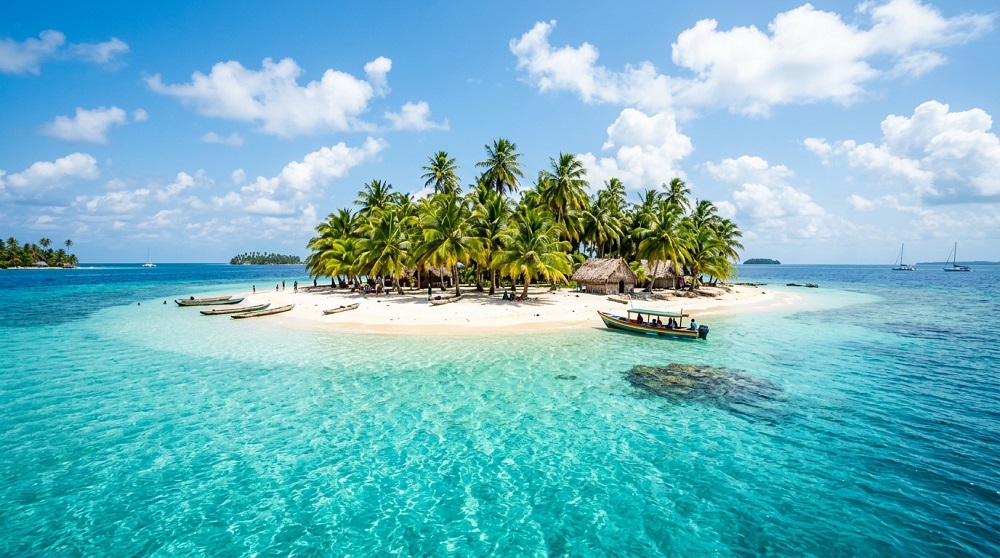
Actually, the San Blas archipelago is known as Guna Yala, an autonomous Indigenous area of about 365 Caribbean islands run by the Guna people, who live along the northeast coast of Panama. In 1925, the Guna rose in rebellion, gaining self-governance over who visits, what is built and how. Knowing about change alters the way you make plans for the trip.
Table of Contents
Getting There
Overland and Boat
The typical route is a 4 x 4 transfer from Panama City to the port at Cartí, which runs about 2.5 hours up a steep mountain track, before the small boat takes you to your island. Please make sure to book transport via authorised Guna operators and you will need your passports at the territory checkpoint.
By Air
Airstrips further east, such as Playón Chico and Achutupu, are served by small aircraft. If you are traveling to the more distant communities, be sure to bring it along.
By boat from Colombia.
Sailings of 4-5 days (open sea and island-hopping) depart and arrive from Cartagena and Guna Yala. A popular route to cross the roadless Darién Gap, but crossing the ocean can be bumpy.
Where You’ll Stay
We deliberately keep the accommodation very simple: cabañas with sand floors and shared bathrooms, with a simple solar or generator power supply and no internet. Fish, coconut rice and plantain are served at the meal time. Overwater huts are available on some of the islands. The accommodation is all owned by Guna and coordinated by Guna or Guna agencies.
The Islands
The Popular Cluster
Cartí is within easy boat reach of the islands of Chichime, Isla Perro and Isla Pelícano. A small shipwreck is in shallow water on Isla Perro, easily snorkelled from the shore.
The Cayos Holandeses
The farther out, and the archipelago at its best, with sandbars, reef, and fewer boats. Worthy of the longer transfer.
The Natural Pool
A patch of shallow sand that is open water and where boats moor and people go feet first to the water, with starfish under their feet. See and don’t pick them up.
Inhabited Communities
There are about 50 permanently inhabited islands, built of thatch and bamboo. Visits are conducted with permission and guide, not wandering in.
Molas and Guna Culture
Guna women sew molas on the reverse-appliqué layers and these are attached to the front of traditional dress together with beaded wini on the arms and legs. Purchases from the maker benefit the local economy and are cheaper than city stores.
Practical Tips
Bring Cash
No ATM or card machines. It is in US dollars and cash will be required for community admission fees, boat transfers, accommodation extras and for molas. Carry extra cash in case you need it.
Insects and Sun
On some islands, sandflies are very aggressive at dawn and dusk, bring with you strong repellent and long sleeves. No shade except palm trees, hat and high factor sun cream are essential.
Photography and Conduct
Please ask before taking photos of people; a small fee is normally expected. In much of the territory, drones are not allowed or are banned. Swimwear is OK on undisturbed islands, but wear clothing in communities.
Medical and Weather
The facilities provided are limited and emergency evacuation is slow and so travel insurance is important. Seas are smoothest from about February to April, and roughest late in the year.
A Changing Coastline
Sea levels are a very real stress. A community, Gardi Sugdub, has already moved to the mainland. Visitors are guests in a place in the midst of negotiating that.
How Long to Stay
The practical minimum is 2 nights, due to the transfer. Three-four lets the speed to settle which is the point of coming.