

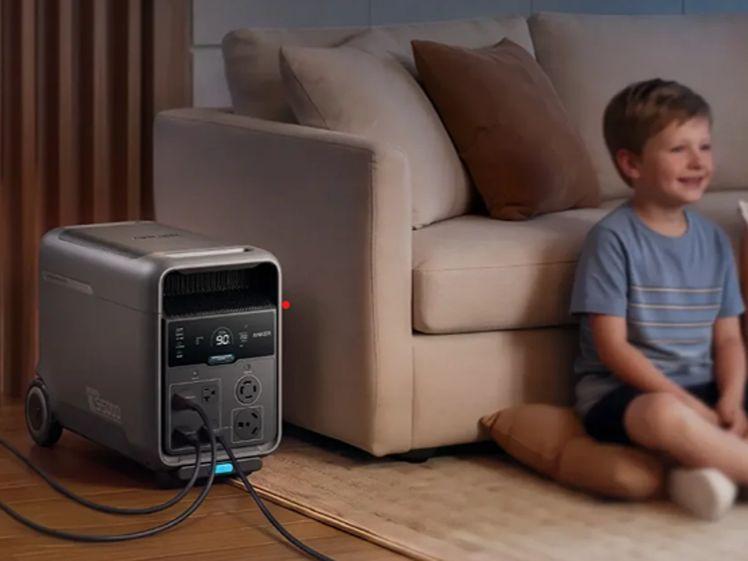
Power outages can interrupt essential household appliances and create uncertainty about keeping medical equipment running. Choosing a portable power station for medical devices requires more than checking battery capacity; voltage compatibility, continuous output, and runtime are equally important. The Anker SOLIX S5000 offers a potential backup solution for compatible equipment, provided its electrical requirements match the unit’s capabilities. This guide explains how to assess compatibility, estimate runtime, and plan reliable backup power for essential appliances and medical devices.
Alt: Portable power station beside sofa
Table of Contents
What Determines Which Appliances the S5000 Can Run?
Three factors determine whether an appliance can operate safely and reliably: available output power, energy capacity, and electrical compatibility.
Rated Output vs. Battery Capacity
The Anker SOLIX S5000 has a 5,024Wh battery capacity, 4,500W rated AC output, and 8,000W peak output. Its 120V/240V dual-voltage design supports compatible appliances operating at either voltage. Output power determines how much electricity the unit can supply at once, while battery capacity indicates how much energy it stores. Check the official product specifications for supported connections and configurations.
Check Voltage, Startup Surge, and Total Load
Before connecting an appliance, check its running wattage, startup surge, and voltage requirements. Compressors, pumps, and motors may briefly draw extra power when starting. Add the running wattage of simultaneously operated appliances to assess the combined load.
Peak output supports brief surges, not sustained operation above the rated limit. Individual outlet limits also apply. For household circuits, use a compatible transfer switch or power inlet installed by a qualified electrician when required. Never connect a power station to a household wall outlet to feed electricity back through the wiring, as dangerous backfeed can result.
Which Essential Appliances Can Anker Solix S5000 Run?
Appliance compatibility depends on electrical demand and intended use. Prioritize essential equipment before adding optional or high-consumption devices.
Refrigerators, Freezers, and Other Everyday Essentials
Refrigerators and freezers help protect perishable food during outages, but compressor startup demand and average energy consumption determine their suitability. LED lights and fans generally consume less power, while routers, phones, and laptops help maintain communication and connectivity.
An independent Bob Vila test reported approximately 86 hours of refrigerator operation. Treat this as a reference rather than a guarantee because refrigerator models, operating conditions, and connected loads differ. Your own appliance’s energy consumption provides a more useful basis for estimating runtime.
Electronics, Lighting, Routers, and Medical Devices
Check the power requirements on device labels and adapters, then calculate the combined demand of equipment operating simultaneously. Usage patterns also matter: a laptop used intermittently consumes less daily energy than one running continuously.
For medical devices, verify the manufacturer’s power requirements and approved backup arrangements. Oxygen concentrators and CPAP machines may need specific configurations, particularly when heated accessories are involved. Confirm compatibility before relying on backup power.
High-Wattage Appliances That Need Careful Planning
Kettles, microwaves, coffee makers, portable air conditioners, and sump pumps can consume substantial energy. Heating appliances draw considerable power while operating, whereas compressors and pumps may require additional startup power.
Central air conditioning and electric cooking equipment need particularly careful assessment of voltage, sustained demand, and connection requirements. Check each appliance’s specifications rather than assuming all high-wattage devices are unsuitable.
How Long Can It Run Them During an Outage?
Estimating energy consumption helps you decide which appliances to prioritize and whether charging will be necessary during a prolonged outage.
Estimate Runtime from Real Energy Use
Use this formula to estimate operating time:
Estimated runtime (hours) = usable battery energy (Wh) ÷ average load (W)
Actual AC runtime is lower than a calculation based on total stored energy alone because of conversion losses and standby consumption. Refrigerators also cycle on and off, so average energy consumption over several hours provides a better estimate than rated running wattage. Use measured energy consumption whenever possible for a more realistic calculation.
Build Practical Backup Scenarios
Choose a backup setup based on your priorities:
- Essential household backup: Refrigerator, router, LED lights, and phone chargers.
- Work-from-home backup: Essential refrigeration, internet access, laptop, and selected lighting.
- Higher-demand backup: Essential devices combined with a portable air conditioner or another high-power appliance.
For example, a combined load averaging 100W for 24 hours consumes 2,400Wh before system losses. Add the daily energy consumption of other devices to estimate your total requirement. This helps you determine which appliances to run and when to conserve energy.
Extend Runtime with Charging and Safe Setup
Compatible AC charging, solar input, generator charging, and supported expansion batteries can help maintain power during longer outages. Charging speed depends on the input source, configuration, and operating conditions.
Before an outage, confirm compatible cables and charging options. During an outage, disconnect unnecessary devices, limit high-power usage, and monitor remaining battery energy. Keep the unit in a suitable, dry, ventilated location and follow its operating instructions. Household circuit backup requires an appropriate inlet or transfer switch installed by a qualified electrician.
Conclusion
The Anker SOLIX S5000 can power many essential household appliances when their electrical requirements match its capabilities. If you are considering a portable power station for medical devices, confirm that the specific device is compatible and follow the manufacturer’s backup guidance before relying on it during an outage. Check running wattage, startup demand, voltage, and expected energy use to estimate runtime and prioritize essential loads.